Gut Training for Runners: 7 Rules I Wish I Followed Sooner

I used to plan my long runs around public bathroom locations. I had already run a handful of marathons and half marathons and I was still white-knuckling every fuel stop, hoping race day wasn't the day my stomach decided to quit on me.
What I didn't understand back then was that while I'd trained my legs for months, I never once trained my gut. Yes, I might have been “fuelling” my runs, but it wasn’t deliberate and it wasn’t training my gut.
That's the piece most runners skip. You build mileage slowly, you respect recovery, you follow a plan for your splits — and then you show up to race day with zero plan for your stomach and wonder why kilometer 32 turns into a sprint to the nearest porta-potty.
Gut training fixed this for me. Not a supplement, not a "sensitive stomach" diagnosis I just had to live with — training. Here are the 7 rules that actually changed things.
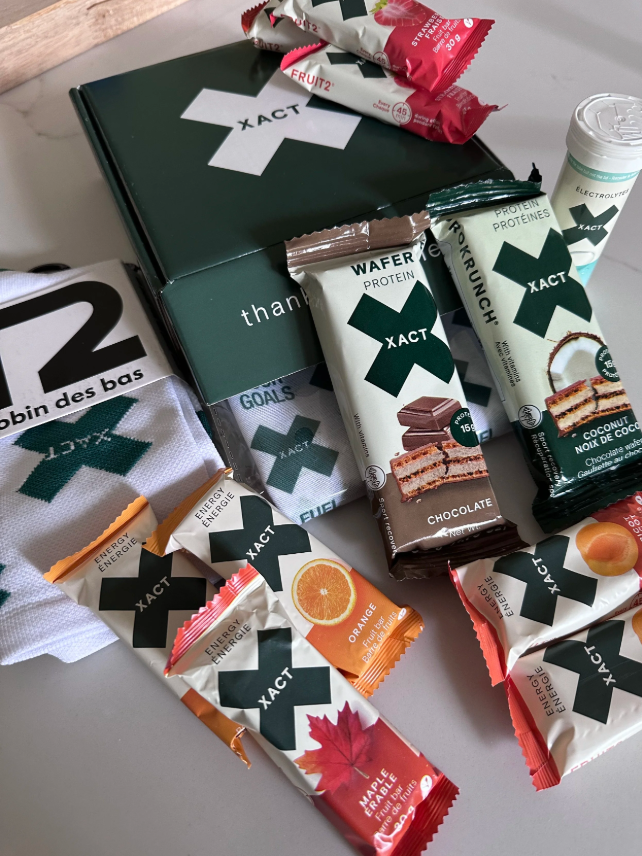
My personal favourite fuelling system: XACT Nutrition made in Canada
1. Understand what's actually happening in that tummy
When you run, blood flow shifts away from digestion and toward your working muscles. Your stomach is already working at a disadvantage before you add fuel into the mix. If you've never practiced taking in carbs under that kind of stress, your body genuinely doesn't know what to do with a gel on race morning and in some cases will reject it and in extreme cases, you might not be sure from which end! This isn't a willpower issue. It's an unpracticed system.
2. Start low, and build slowly
If you're currently taking in little to nothing during training runs, don't jump straight to 60-90g of carbs per hour because a brand's marketing told you to. Start small, maybe a half a gel that’s around 15-20g per hour on your long runs. Try an easy carb before a shorter workout and see how that settles. Give your gut two to three weeks there before increasing. Same logic as mileage: you didn't run a marathon off a 5K base, and your gut doesn't adapt to carb volume any faster than your legs adapt to distance.
3. One test run isn't gut training
This is the one I see constantly. A runner tries their race nutrition exactly once, on the final long run before taper, and calls it good. That's a guess with good intentions, not gut training. Real gut training means practicing your fuelling strategy on multiple runs in a row, with enough repetition that your gut actually adapts. You should also try fuelling and different efforts and conditions. Heat and speed can have very different gut impacts that can only be tested in practice.
4. Save the fiber and fat for after, not before
Raw veggies, legumes, fried food, big salads — I love these foods. Just not in the hours before a run. Save them for recovery meals, when your gut has the blood flow and bandwidth to process them. Eating these types of foods pre-run is one of the fastest ways to end up with GI distress that has nothing to do with your fuelling plan and everything to do with your pre-race meal(s).
5. Fuel early, fuel often
My biggest rule with clients, full stop: fuel early, fuel often. Don't wait until you feel like you need fuel. By the time you might feel “hungry” and/or fatigue sets in, you're already behind. Start your first gel or chews around 20-30 minutes in, then keep fuelling consistently every 20-45 minutes after that. A steady stream beats playing catch-up every time. The time in between also comes from practice and knowledge. The longer the distance and the harder the effort should help determine when to fuel.
6. Test more than one product
Not every gel or chew agrees with every gut, and that's useful information, not a dead end. If one brand consistently causes trouble, swap it out and test something else on your next long run instead of deciding all race fuel is the enemy. These days there are so many options to choose from. From high end (and increasingly expensive), to DIY and “real food” options, not fuelling should NOT be an option.
7. Don't skip hydration and electrolytes
Dehydration alone can cause GI symptoms that have nothing to do with what you ate. If you're sweating heavily or racing somewhere warm, gut training needs to include practicing your fluid and electrolyte intake too, not just your carbs.
Electrolytes were the game-changer for me, personally. Once I discovered I was a very salty sweater, I immediately started putting more focus on my hydration and electrolytes. What I thought was initially underfuelling, was actually under hydrating and not enough electrolytes to make up for what I was losing. No more post run headaches, no more emergency bathroom stops and such a more enjoyable way to run!

Me finishing my first North Shore Knee Knacker trail race
What this looks like in race week
By race week, gut training isn't about trying anything new. It's about locking in what's already worked. Use your final long run or a taper shakeout to do one last full run-through of your race morning breakfast and in-race fuelling, timed the way you'll do it on race day. If it's worked in training, trust it — this is not the week to try a new gel because someone in your run club swears by it. Carb loading fits in here too, but gradually over 2-3 days, not as one giant pasta dinner the night before. That one meal is where a lot of runners accidentally undo weeks of good gut training.
The bottom line
Your gut is trainable. GI distress on race day isn't a personality trait, it's a training gap, and training gaps close with practice. If you're heading into a race and still hoping your fuelling holds up rather than knowing it will, that's exactly what we fix together inside Fuelled to Finish, my 1:1 coaching program for endurance runners.

Want a fueling plan that’s as personalized as your training plan?
Inside my Endurance Essentials Program, I’ll show you exactly how to fuel for marathon training, prevent underfueling, and run your strongest race yet.
Like this post and want to read more? Check out my other resources:

Just ask!
I love helping clients develop meal plans that pack all the nutrients that they need into meal plans and recipe books!